
Integrative Trauma Treatment in Practice
Format: 3 monthly live sessions · 2 hours each · Zoom
Feb 23 | Mar 17 | Apr 17
12-2pm ET

A practical, case-driven consultation series for clinicians who want to deepen their capacity to work flexibly and confidently with complex trauma presentations. Frank Anderson, MD, will demonstrate an integrative, neuroscience-informed, parts-aware approach to clinical decision-making—showing how to assess, intervene, and adapt moment-to-moment while maintaining a non-pathologizing stance and a grounded therapeutic alliance.
At the core of Frank’s teaching is true integration: understanding how to identify what the moment calls for and choosing the modality that best supports the client’s system. Throughout the series, Frank will teach you how to incorporate essential skills from various models—pulling from EMDR, somatic and embodiment approaches, parts-informed therapies, attachment-based models, polyvagal principles, mindfulness, and meaning-making—and demonstrate how to weave them together in real time. He will highlight how to recognize the signals that indicate when to slow down and work with regulation, when to strengthen internal communication, when to incorporate body-based orientation, when explicit processing may help, and when coaching-style forward movement is stabilizing. This is integrative work in real time—grounded, practical, and clinically responsive.
Every clinician encounters sessions where symptoms don’t follow predictable patterns: dissociation that appears suddenly, shame that shapes every response, attachment dynamics that pull the work off course, or arousal patterns that shift faster than clients can track. In these moments, the task is not only to understand what’s happening, but to respond in a way that is steady, attuned, and clinically sound.
This series creates a professional space for clinicians to learn in community, reflect on real cases, and build confidence in applying an integrative lens to trauma treatment. With guidance from Frank—drawing on more than three decades of experience—participants will strengthen their clinical judgment, sharpen their use of micro-interventions, and deepen their ability to support stability, meaning-making, and long-term integration.
Program Details
Duration: 3 months (1 session per month)
Format: Live, online sessions (120 minutes each)
Who It’s For: Mental health professionals—therapists, counselors, psychologists, social workers, and advanced trainees—seeking integrative, parts-aware consultation for high-complexity trauma presentations.
Investment: $450 total for all three sessions (capacity limited; waitlist available)
What Participants Will Gain
Clearer, more organized ways to assess and formulate complex presentations
including dissociation, arousal shifts, shame cycles, attachment patterns, and co-occurring issues.
Practical micro-skills for staying within capacity
such as adjusting pace, titration, orienting, stabilizing language, and helping clients differentiate present experience from past activation.
A deeper understanding of how to choose and apply different modalities in real time
including polyvagal-informed regulation work, somatic tracking, parts-aware interventions, EMDR-informed strategies, mindfulness, and relational/attachment-based approaches—and how to recognize which modality best supports the client’s system in the moment.
Guidance for implicit and explicit work
including how to track sensory and affective cues, support body-based awareness, and introduce meaning-making when it becomes helpful.
Strategies for relational repair and stability
with attention to co-regulation, rupture–repair processes, internal and external continuity, and the clinician’s ability to stay grounded and connected.
Risk-responsive planning for dysregulation and safety
including coordination of care, monitoring thresholds, and supporting clinician sustainability with high-intensity cases.
Focus Areas (high-level)
This series supports work across the spectrum of complex trauma, dissociation, attachment injuries, and common comorbidities. Emphasis will be placed on safety, consent, co-regulation, compassionate internal leadership, present-moment differentiation, and sustainable integration across implicit and explicit therapeutic processes.
Case Consultation
Each session includes live consultation on anonymized cases. Registered participants may submit brief case summaries; a limited number will be selected for discussion or demonstration. All identifying information must be removed or altered (names, dates, locations, unique demographic characteristics).
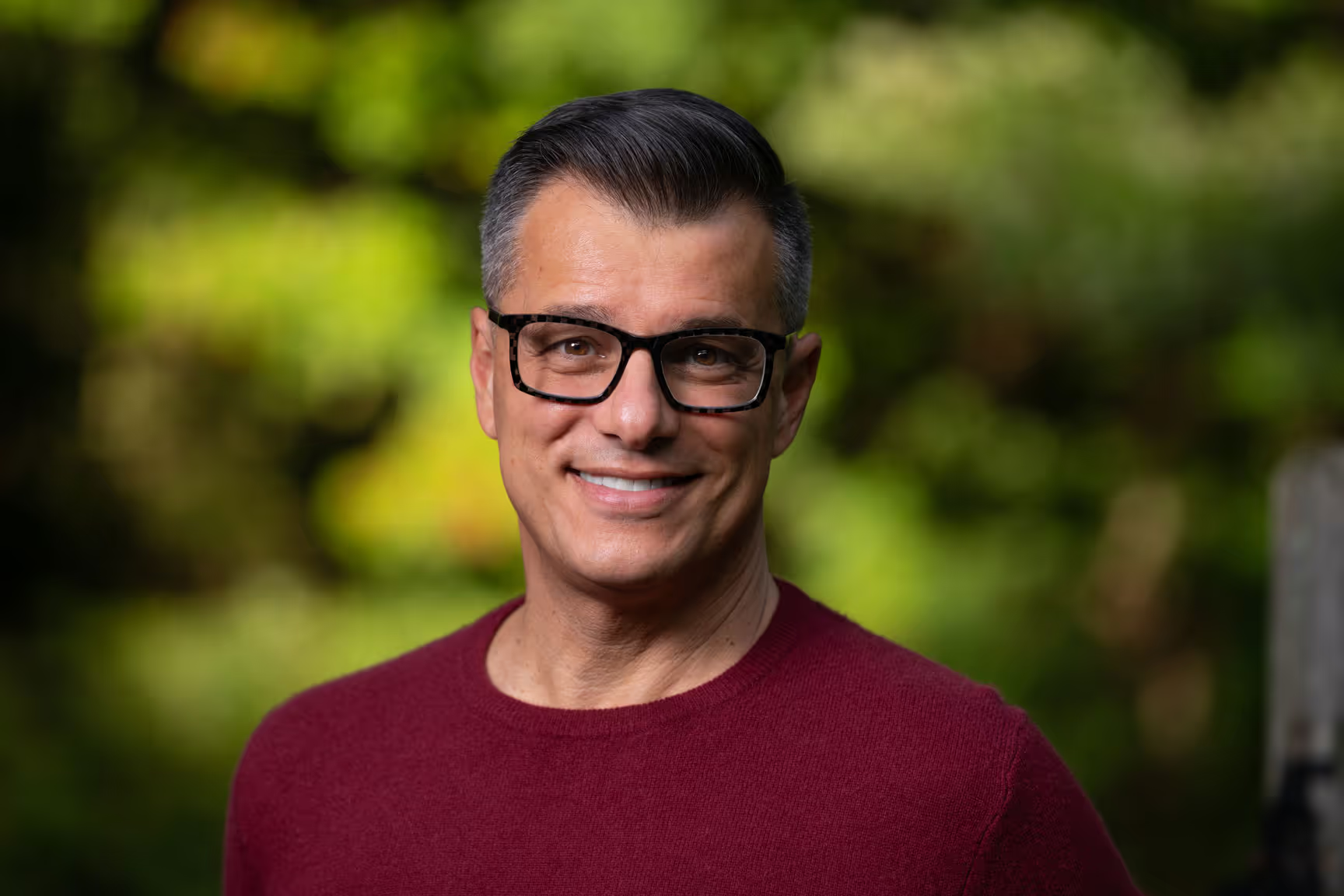
With a background in psychiatry and trauma treatment, Frank specializes in helping individuals and clinicians understand how IFS can heal emotional wounds and create meaningful change. His work blends IFS, neuroscience, and personal transformation, making complex ideas easy to grasp and apply in real-world settings.
A Trusted Voice in IFS, Trauma Healing & NeuroscienceWhen it comes to IFS, trauma healing, and neuroscience, few voices are as trusted and influential as Frank Anderson, MD.
A psychiatrist, author, and globally recognized speaker and teacher, Frank has dedicated his career to helping individuals and clinicians unlock deep emotional healing through IFS. His expertise bridges the worlds of clinical practice, neuroscience, and personal transformation, making IFS accessible, practical, and deeply impactful.
In this program, you’re not just learning about IFS—you’re learning directly from one of the field’s most sought-after teachers. Through live case studies, interactive discussions, and real-world applications, Frank will guide you in understanding how IFS works in action—and how it can be applied to your life or practice.
Frequently Asked Questions (FAQ)
This series is designed for mental health professionals (and advanced trainees) who work with trauma and want consultation on complex presentations.This is not a certification program and does not confer any credential.
You may request a full refund up to 7 calendar days before the first live session begins. After that point, all sales are final.
Your registration covers the full program (all dates). We’re unable to offer partial refunds, credits, or prorations if you miss one or more sessions.
To protect participant privacy and due to the sensitive nature of live case material and demonstrations, sessions are not recorded and replay is not available.
We occasionally offer promotions or sale prices. Refunds or credits won’t be issued to match a past or future discount if you purchased at a different price.
No. To maintain confidentiality and respect the privacy of the case discussions, sessions will not be recorded. We encourage attending live to receive the full value.
Yes. Each session includes live Q&A and group discussion, along with Dr. Anderson’s live formulation/demonstration when appropriate.
Registered participants may submit brief case summaries in advance for consideration.
- Cases must be thoroughly anonymized—remove or alter names, dates, locations, and any identifying details.
- Dr. Anderson will select a limited number of cases that offer strong learning value for the group.
- If selected, you’ll present the case live, engage in discussion, and receive guidance on clinical decision-making with complex trauma presentations.
Note: Not all submitted cases can be included due to time limits.
•Three live, interactive 2-hour large-group consultation sessions with Dr. Frank Anderson
•Case demonstrations and real-time clinical discussion
•Live Q&A with Dr. Anderson
•A community of peers working with high-complexity trauma presentations
This series is educational consultation. It is not therapy and does not replace employer/board-required clinical supervision. If you need supervision toward licensure, please follow your local requirements.
📢 Enrollment is limited! Secure your place in this exclusive learning experience with Frank Anderson.
Need Help?
For support with courses, programs, or consultation groups, please contact programs@frankandersonmd.com